
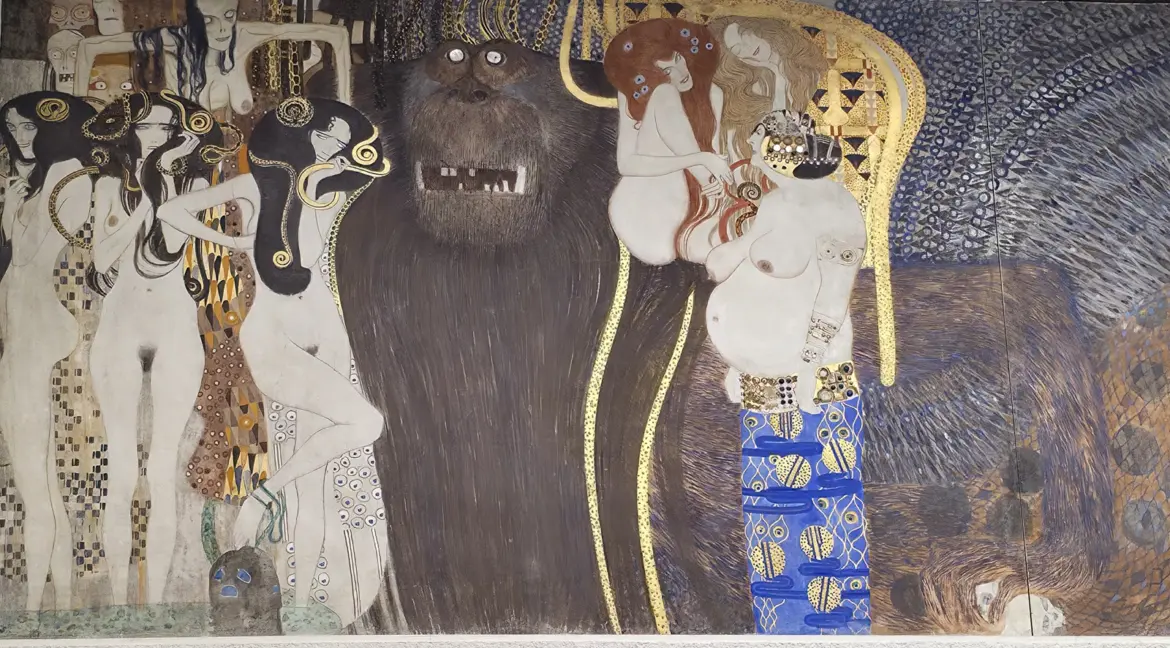
There are works of art that you admire, and then there are works you move through, slowly, almost instinctively, as if they are guiding you. Hidden beneath the Secession Building, the Beethoven Frieze is one of those rare experiences.
Descending into the space where it is housed, the atmosphere shifts. The light softens, the noise of the city fades, and what remains is a quiet, almost contemplative environment. It does not feel like a grand museum hall or an overwhelming gallery – it feels intimate, focused, as though everything has been designed to bring your attention inward. And then, gradually, the frieze begins to unfold around you.
Beethoven Frieze at a Glance
🎨 Artist: Gustav Klimt — created in 1902 for the XIV Vienna Secession exhibition
🎵 Inspiration: Beethoven’s Ninth Symphony, interpreted through Richard Wagner’s philosophical lens
🏛️ Location: Lower gallery of the Secession Building, Friedrichstraße 12, Vienna
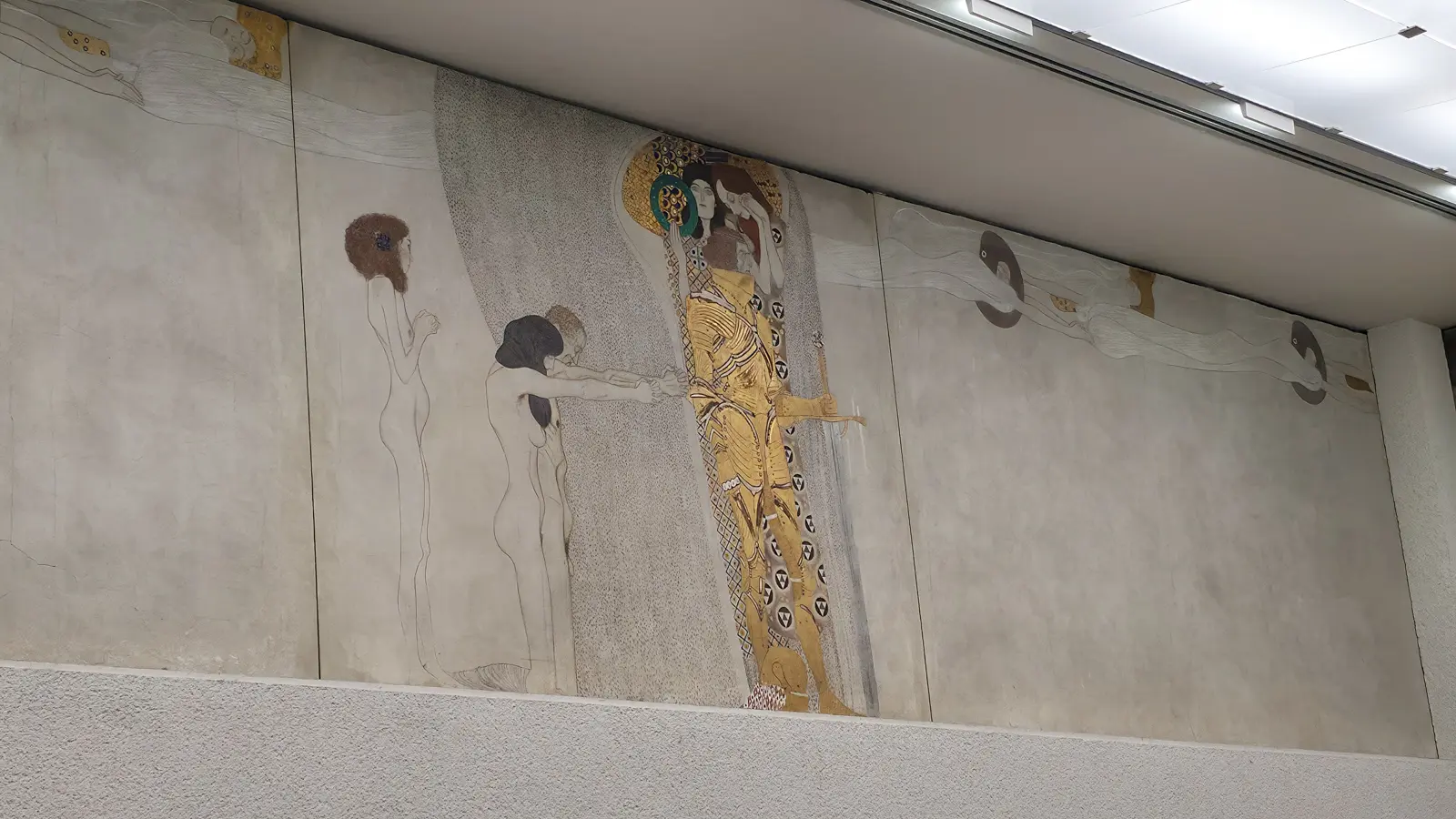
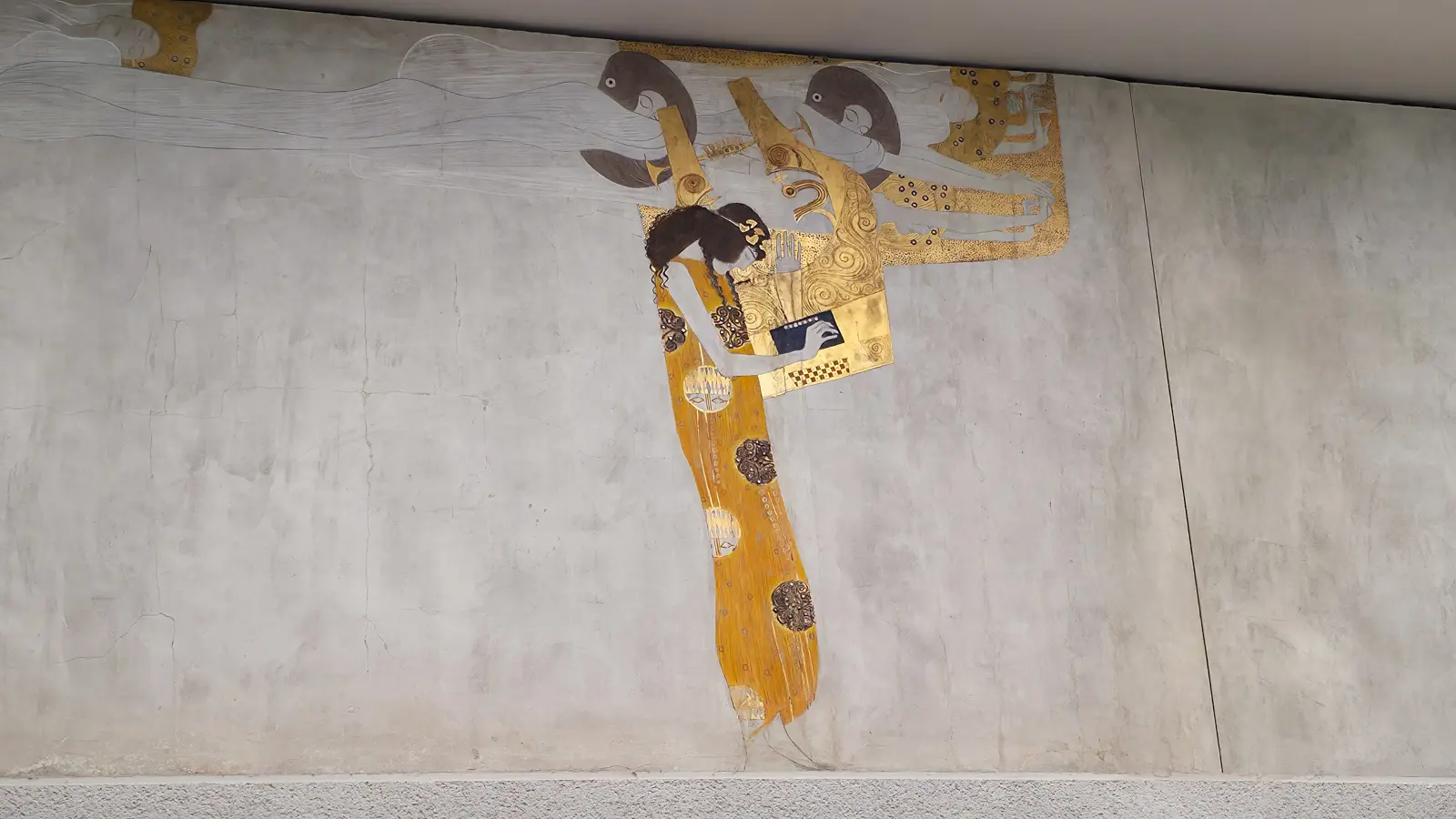
⬅️ Left wall: Humanity’s yearning for happiness — fragile figures, a knight called to struggle
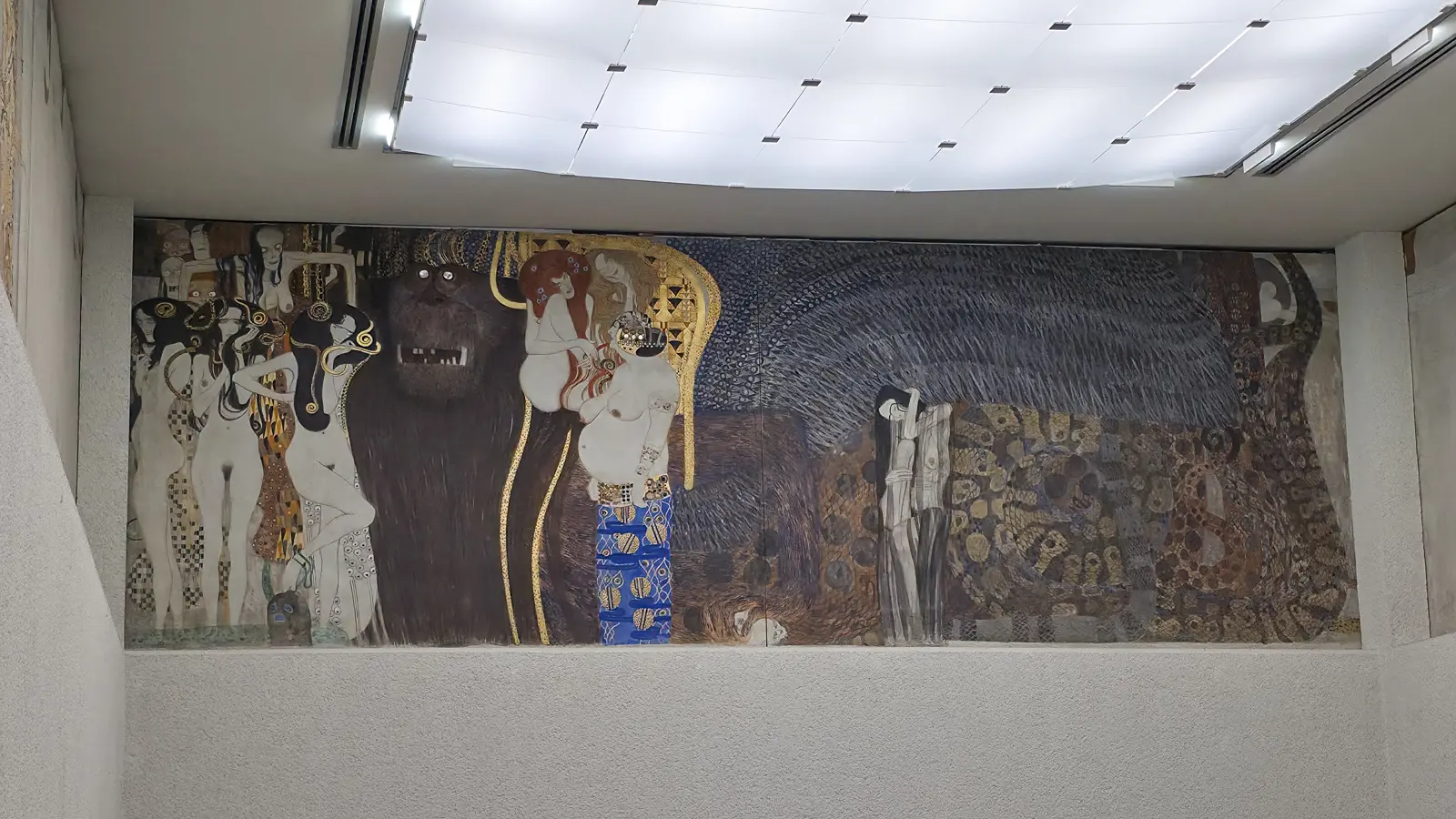
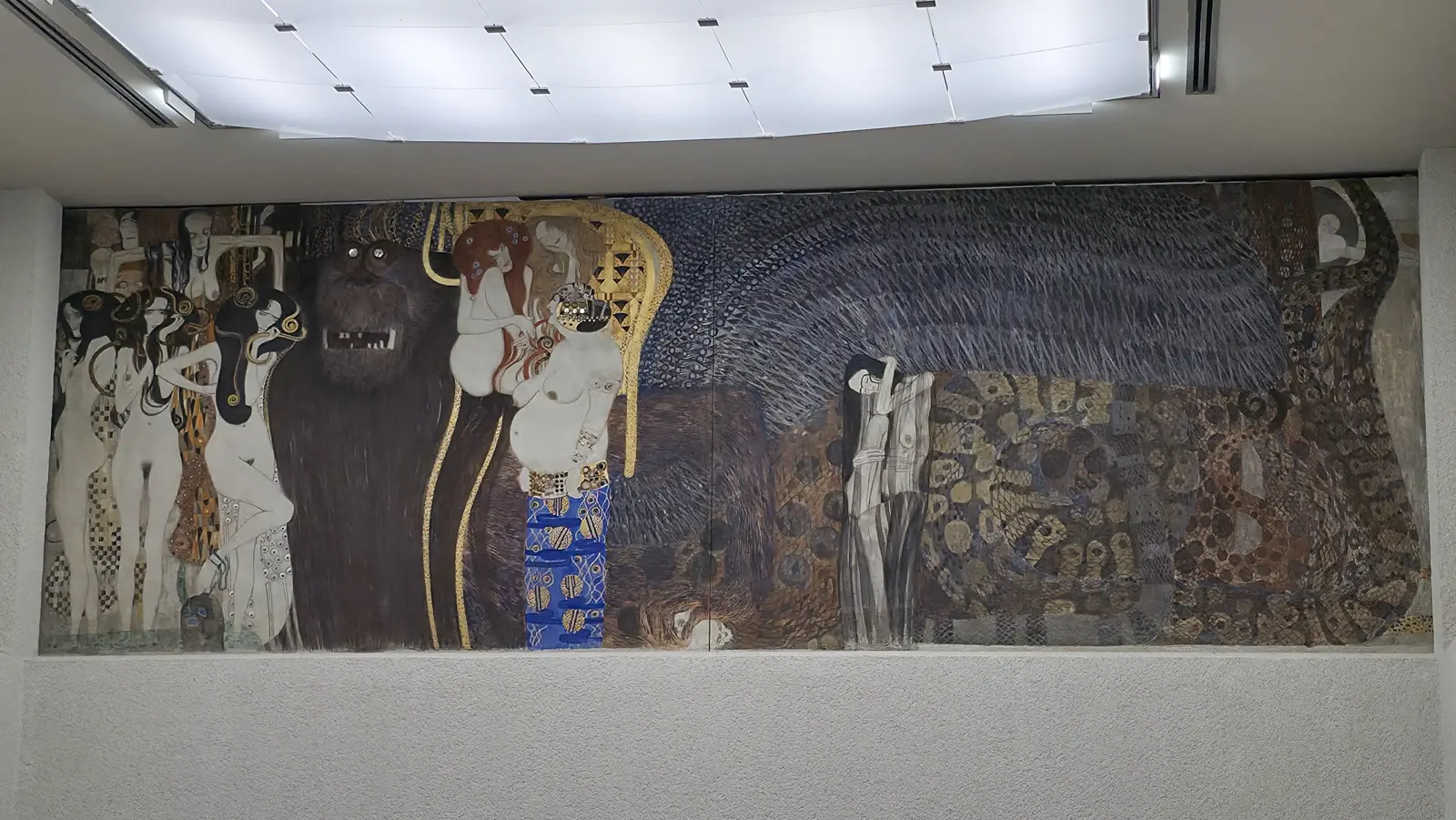
⬆️ Central wall: Hostile forces — Typhon, the Gorgons, sickness, madness, death
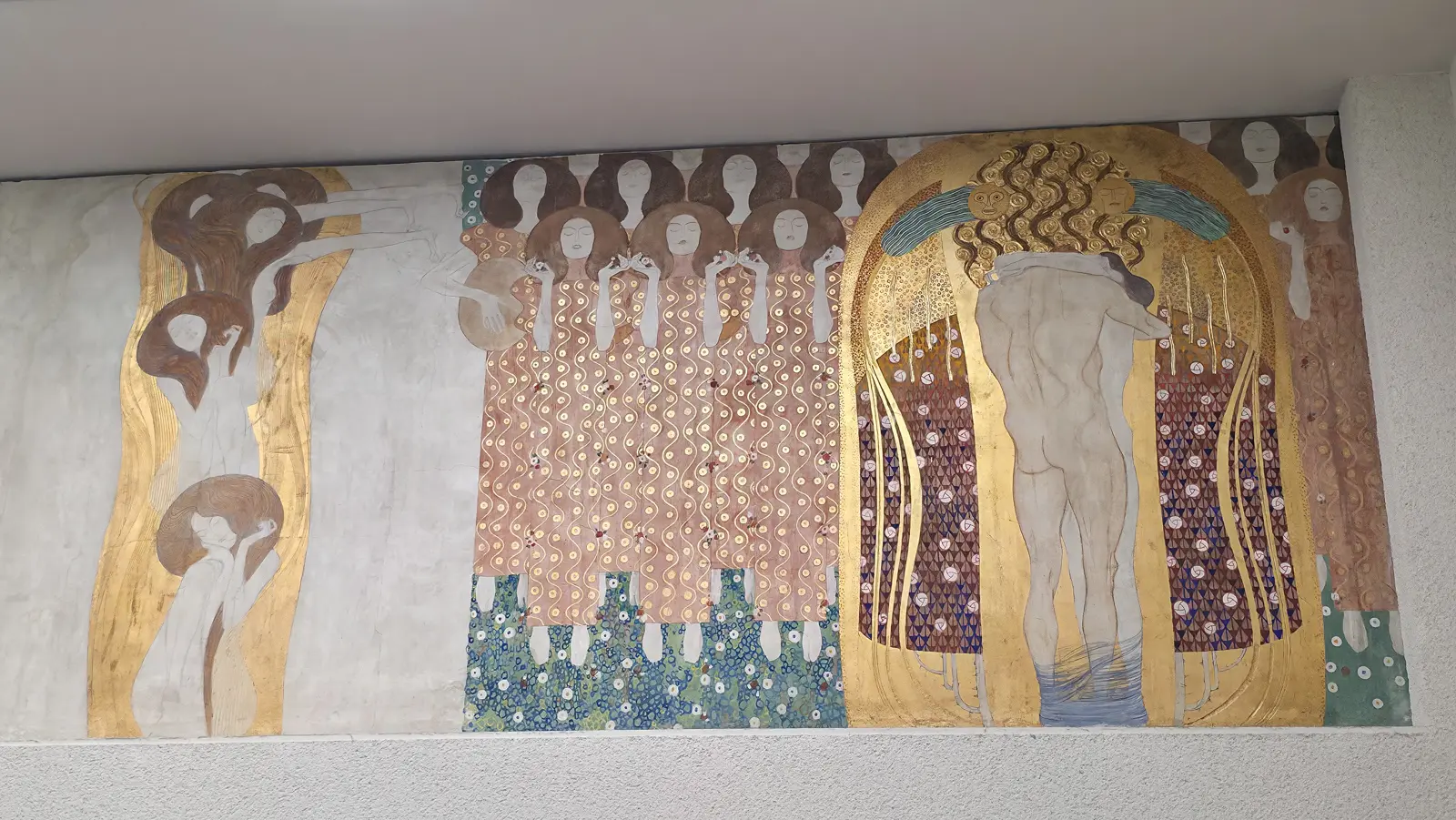
➡️ Right wall: Resolution — harmony, love, and an embrace echoing the Ninth Symphony’s “Ode to Joy”
⚔️ Controversy: Called disturbing, incomprehensible, and obscene at its 1902 unveiling
🔥 Survival: Nearly destroyed — created for a temporary show, displaced in WWII, restored to the Secession
✨ Significance: Marks the transition toward Klimt’s celebrated Golden Period
💡 Tip: Move along the walls in sequence and pause at the central panel — the narrative unfolds gradually
A Vision of Unity: Art, Music, and Meaning
The Beethoven Frieze was created in 1902 by Gustav Klimt for the XIV Exhibition of the Vienna Secession, an exhibition unlike any other at the time. It was conceived as a tribute to Ludwig van Beethoven, inspired by his Ninth Symphony and interpreted through the philosophical lens of Richard Wagner. Rather than illustrating the music directly, Klimt translated its emotional and symbolic depth into a visual language, allowing viewers to experience its themes in an entirely new way.
The goal was ambitious and deeply idealistic: to unite the arts into a single, immersive experience. Architecture, painting, sculpture, and music were brought together to form what the Secessionists envisioned as a total work of art. At the center of the exhibition stood Max Klinger’s monumental Beethoven sculpture, anchoring the space both physically and symbolically, while Klimt’s frieze wrapped around the walls, guiding visitors through a narrative that unfolded as they moved. The experience was carefully orchestrated, encouraging viewers to engage not with individual works, but with the environment as a whole. Today, that original installation no longer exists in its entirety (the sculpture has since been relocated) yet the frieze continues to echo that vision, offering a more intimate encounter that still carries the spirit of the whole.
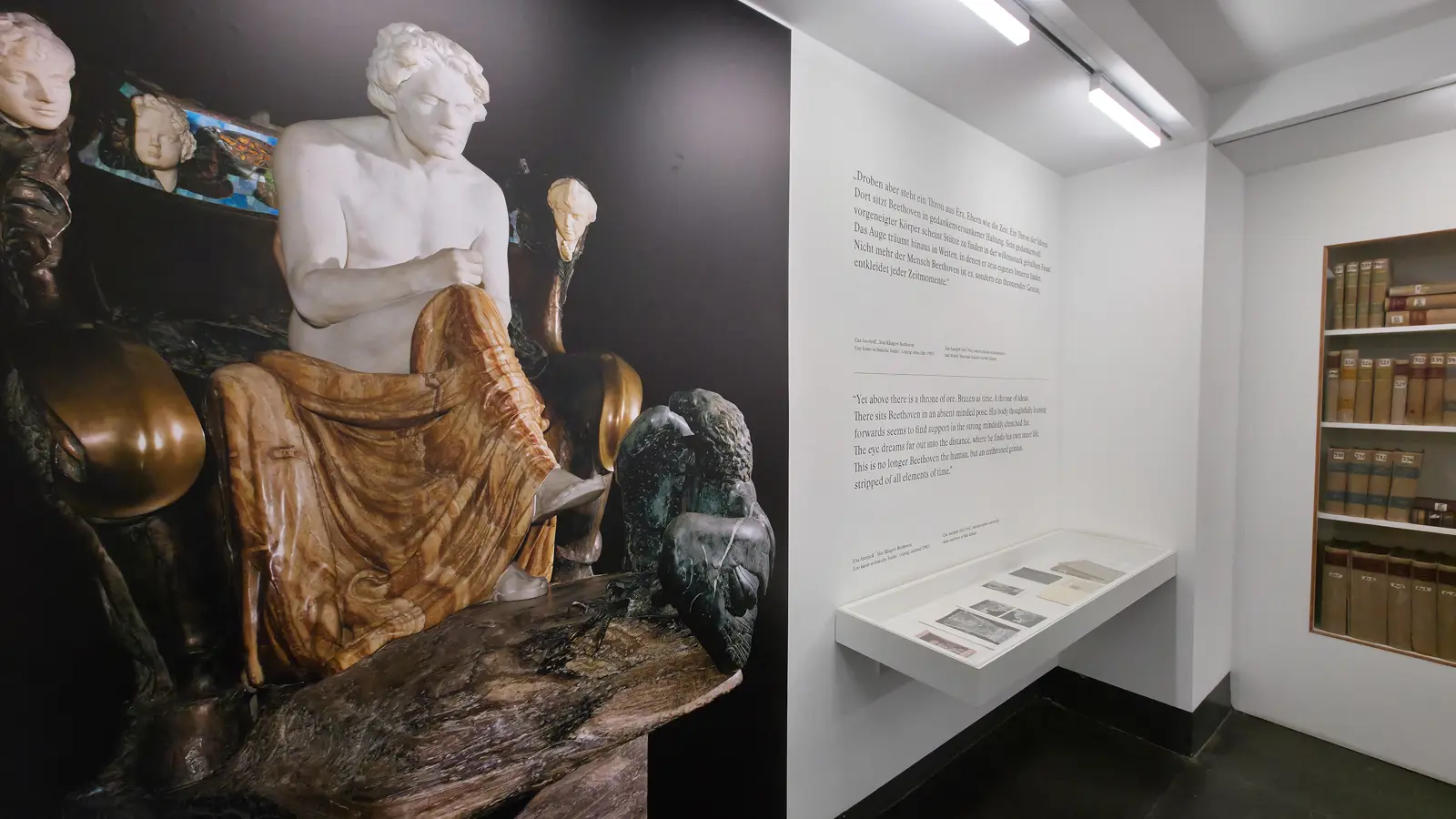
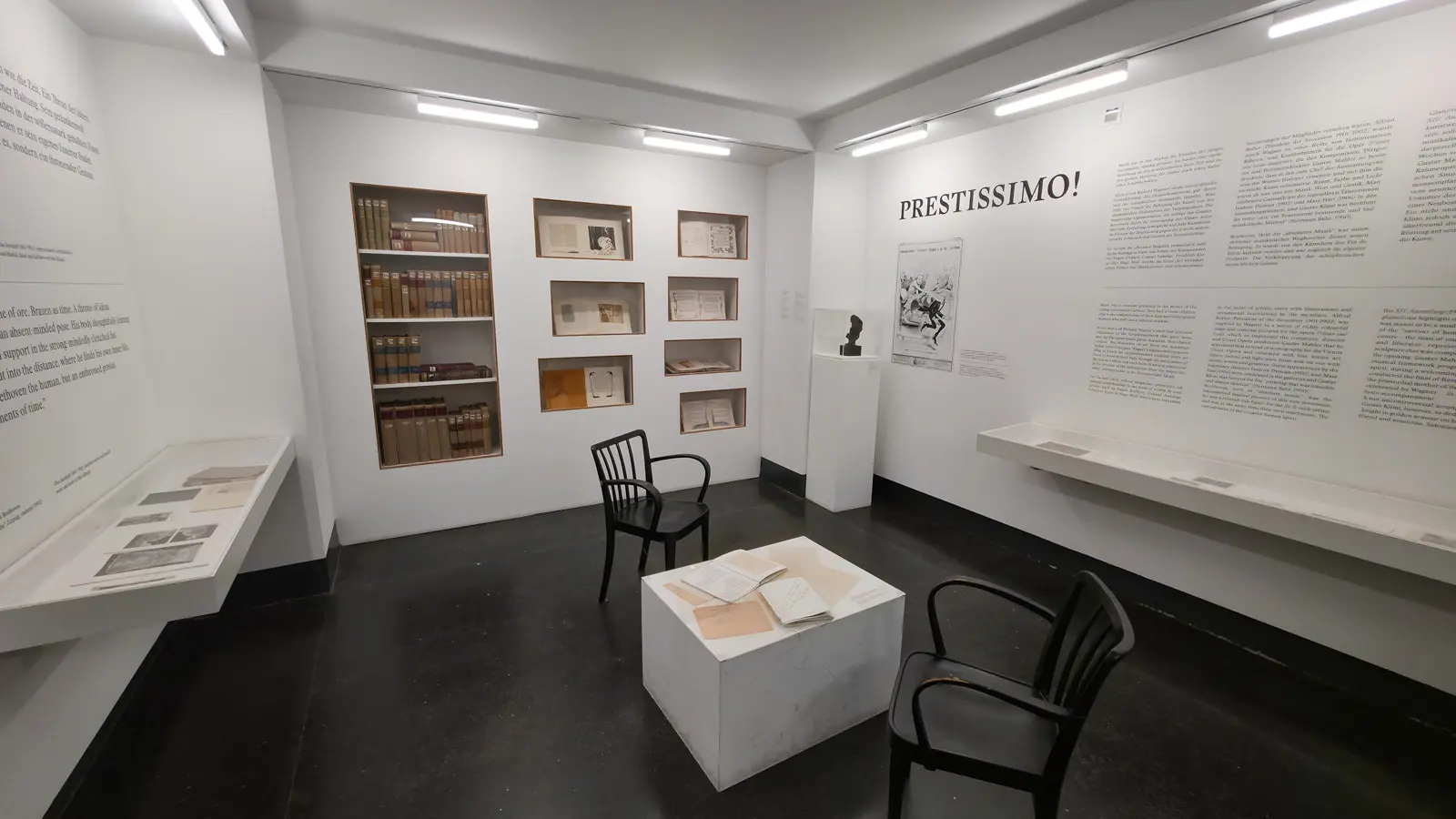
Even today, that intention can still be felt. The frieze is not just something to observe, it is something to experience as part of a larger artistic vision, one that invites you to slow down and move through it with intention. There is a sense that you are not standing outside the work, but within it, following a path that connects sound, space, and image into a single, unified expression.
The Story Unfolds: A Journey Toward Happiness
What makes the Beethoven Frieze so compelling is that it tells a story – one that unfolds across three walls, guiding you through a symbolic journey that feels both personal and universal.
On the left wall, the narrative begins with longing. Fragile, almost weightless figures – often interpreted as humanity – drift through space, expressing a yearning for happiness. They are vulnerable, searching, uncertain. Their gaze turns toward a knight, a figure of strength and resolve, who is called upon to take up the struggle on their behalf. It is a quiet beginning, filled with hope, but also with an awareness of what lies ahead.
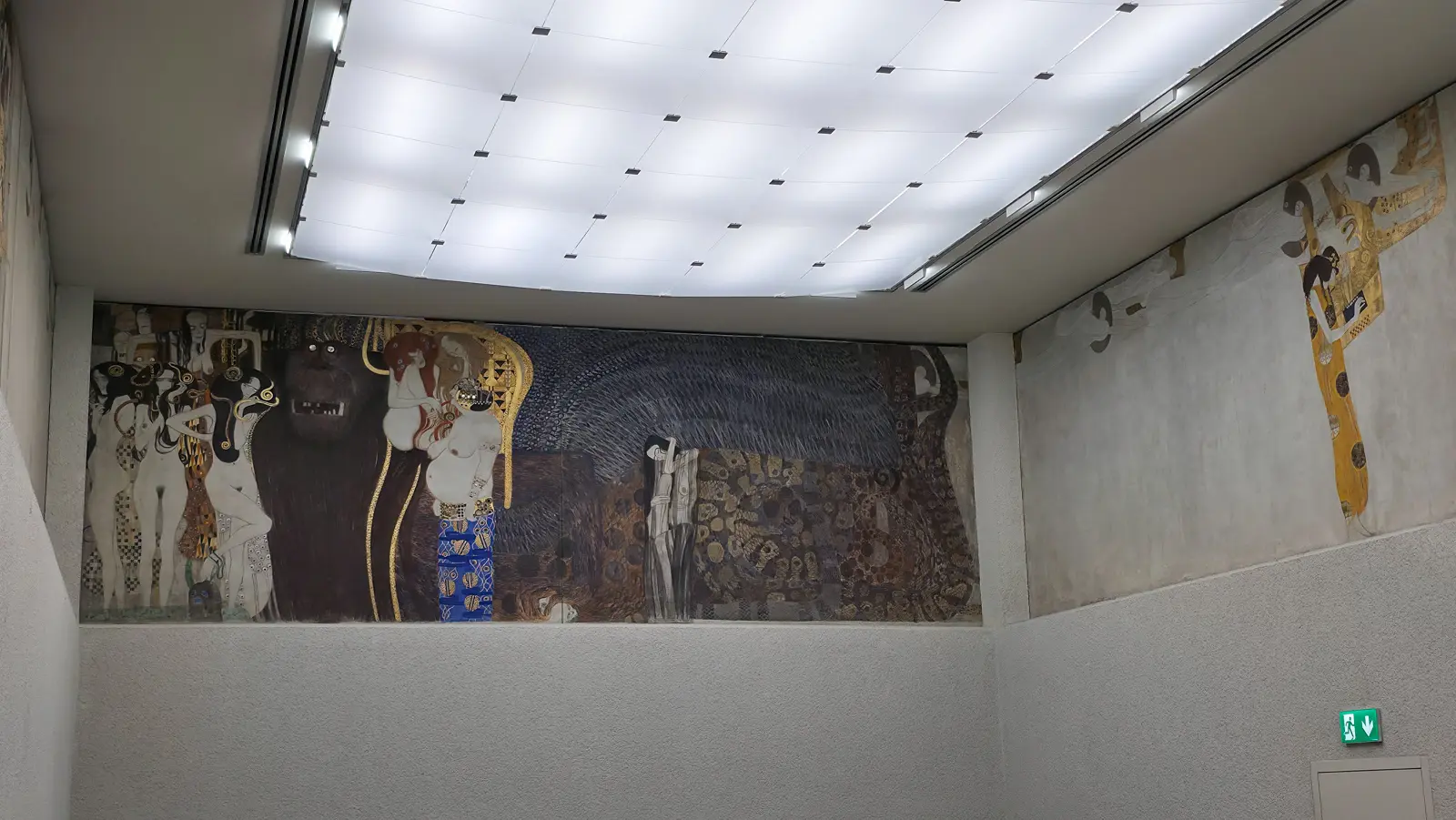
The central wall shifts dramatically in tone. Here, the “hostile forces” emerge – powerful, unsettling figures that represent the obstacles to human fulfillment. The monstrous Typhon dominates the scene, flanked by the three Gorgons, embodiments of lust, excess, and destructive desire. Around them appear personifications of sickness, madness, and death, rendered with an intensity that was shocking to audiences at the time. The imagery is raw, expressive, and deeply symbolic, a confrontation with the darker aspects of existence that cannot be avoided.
And then, gradually, the narrative moves toward resolution. On the right wall, the atmosphere changes. The struggle gives way to something softer, more transcendent. Art itself becomes the path forward, leading humanity toward an ideal realm of beauty, love, and fulfillment. The figures become more harmonious, more serene, culminating in an embrace that echoes the universal message of Beethoven’s Ninth Symphony: joy, unity, and connection.
Klimt’s Language: Ornament, Symbolism, and Emotion
In the Beethoven Frieze, Gustav Klimt moves beyond traditional representation and into something more expressive, more symbolic. The human form is flattened and stylized, freed from strict realism, while lines become fluid and intentional, guiding the eye across the surface. Ornament takes on a central role in the composition, not as decoration, but as an essential part of how the story is told, shaping both the visual rhythm and the emotional tone of the work.
Gold accents, intricate patterns, and decorative elements are not simply aesthetic choices, they are part of the narrative itself. They create rhythm, movement, and emotion, drawing the viewer from one figure to the next, from one moment to another. Surfaces shimmer, textures shift, and the boundaries between figure and background begin to dissolve. It is here that Klimt begins to fully embrace what would become his signature style, marking an important moment in the transition toward his celebrated “Golden Period”, where ornament and meaning become inseparable.
There is a sense that nothing is accidental. Every figure, every line, every detail contributes to a larger story – one that unfolds gradually, revealing itself through observation and feeling. The frieze invites you to look closely, but also to experience it intuitively, as something that resonates beyond logic. It is not only a visual composition, but an emotional language, one that lingers long after you have moved on.
Controversy and Reaction: Art That Challenged Its Time
Today, the Beethoven Frieze is widely admired. But at the time of its unveiling, it was anything but universally accepted. Many critics and members of the public were unsettled, even outraged, by what they saw. The expressive forms, the symbolic imagery, and especially the depictions of desire and suffering were described as disturbing, incomprehensible, and even obscene. The central wall, with its intense and unsettling figures, drew particular criticism, challenging conventional ideas of beauty and representation.
And yet, this reaction is part of what makes the work so significant. It reflects the very tension that the Secession movement sought to address: the struggle between tradition and innovation, between expectation and expression.
A Fragile Survival: The Frieze That Almost Disappeared
What makes the Beethoven Frieze even more remarkable is that it was never meant to last. Created as part of a temporary exhibition, it was originally intended to be removed – and likely destroyed – once the exhibition ended. That it survives today is the result of a series of fortunate decisions, careful preservation efforts, and moments of unexpected continuity.
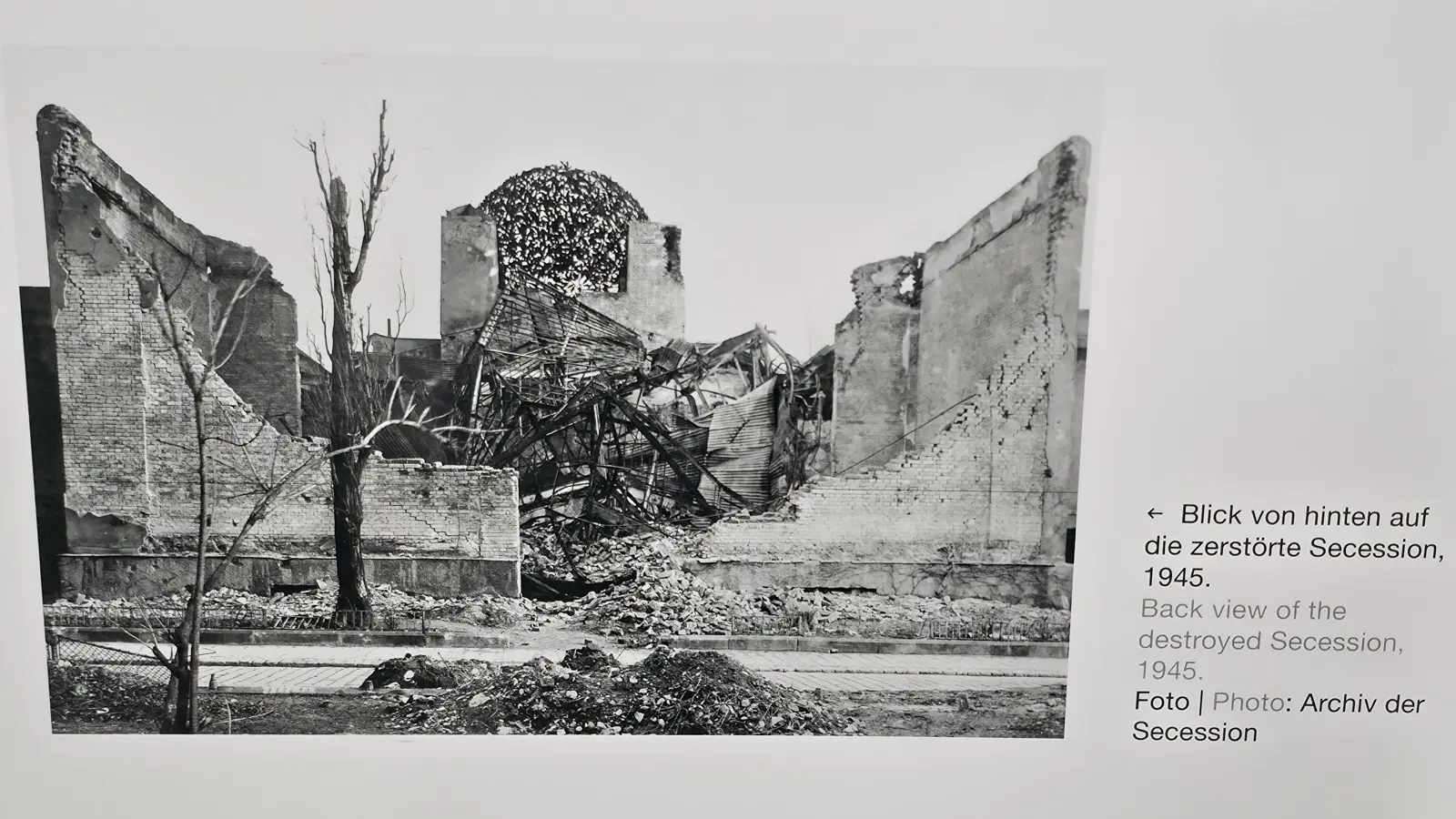
The frieze was eventually purchased, removed from the walls in sections, and stored for years. It passed through different hands and endured periods of neglect, but its most uncertain chapter came during the upheavals of the 20th century, particularly World War II. Under the Nazi regime, the collection to which it belonged was seized, and like many important works of art, it was displaced and hidden away during the war years. At the same time, the Secession Building itself was heavily damaged during the final years of the war. That the frieze and the building would ultimately survive – apart, and then together again – feels almost improbable. Only later was it carefully restored and given a permanent home within the Secession Building, in a specially designed space that allows it to be preserved under optimal conditions while also offering a more intimate and focused way of experiencing the work.
Knowing this history adds another layer to the experience. You are not just looking at a work of art, you are standing before something that came close to being lost, yet endured through time, conflict, and change. It is a quiet testament not only to artistic vision, but to resilience itself.
The Experience Today: Quiet, Intimate, Reflective
Experiencing the Beethoven Frieze today is unlike visiting a typical gallery. The space is calm, almost meditative, inviting a slower, more deliberate way of moving. The scale of the work surrounds you, yet the atmosphere remains intimate, encouraging you to pause, to look closely, and to take in each detail as it reveals itself. Some visitors absorb the frieze as a whole, while others follow it panel by panel, allowing the narrative to unfold gradually. At times, Ludwig van Beethoven’s Ninth Symphony fills the space, creating a powerful connection between sound and image, a quiet echo of the original vision behind the work. The experience becomes immersive, not in a technological sense, but in an emotional one, where reflection feels as natural as observation.
Bubbly Tips: Experiencing the Beethoven Frieze
To fully appreciate the Beethoven Frieze inside the Secession Building, consider the following:
- Take your time – this is not a quick visit, but a work that reveals itself gradually
- Move along the walls in sequence to follow the narrative from beginning to end
- Pause at the central panel – it is the most intense and symbolically rich section
- Look closely at the details – ornament, expression, and line all carry meaning
- Allow space for reflection – the emotional impact is part of the experience
- If available, listen to Beethoven’s Ninth Symphony while viewing for a deeper connection
- Visit during quieter hours to fully absorb the calm, intimate atmosphere
- Check current opening hours and admission before your visit – entry to the frieze is typically included with admission to the Secession, though access may vary depending on exhibition periods
Final Thoughts
The Beethoven Frieze is not just a masterpiece, it is a journey. A reflection on human longing, struggle, and the search for something greater.
It speaks of vulnerability and strength, of darkness and light, of the enduring role of art in helping us understand ourselves and the world around us. More than a century after its creation, it continues to resonate – not because it offers simple answers, but because it invites deeper questions.
Standing before it, you are reminded that art is not only something we observe, it is something we feel, something we carry with us, long after we leave.
I’d love to hear from you. Have you experienced the Beethoven Frieze, or is it on your Vienna list?
Happy travels!

🌟 Everything You Need to Plan Your Dream Trip in 2026
- 🌟 Luxury Hotels - Find premium stays with Booking.com & Hotels.com
- 🏡 Vacation Rentals - Discover unique properties on VRBO
- 🏞️ Guided Tours - Explore with Viator or GetYourGuide
- 🎫 Attraction Tickets - Skip the lines with Tiqets
- 🚢 Ocean Cruises - Set sail with Cruise Direct
- 📱 International SIMs - Stay connected with Saily
- 🚗 Car Rentals - Budget-friendly options from Discover Cars
- 🌐 Secure VPNs - Browse safely with NordVPN
- 💶 Currency Exchange - Best rates with Wise
- 🗣️ Learn Languages - Master the local language with Babbel and Rosetta Stone