
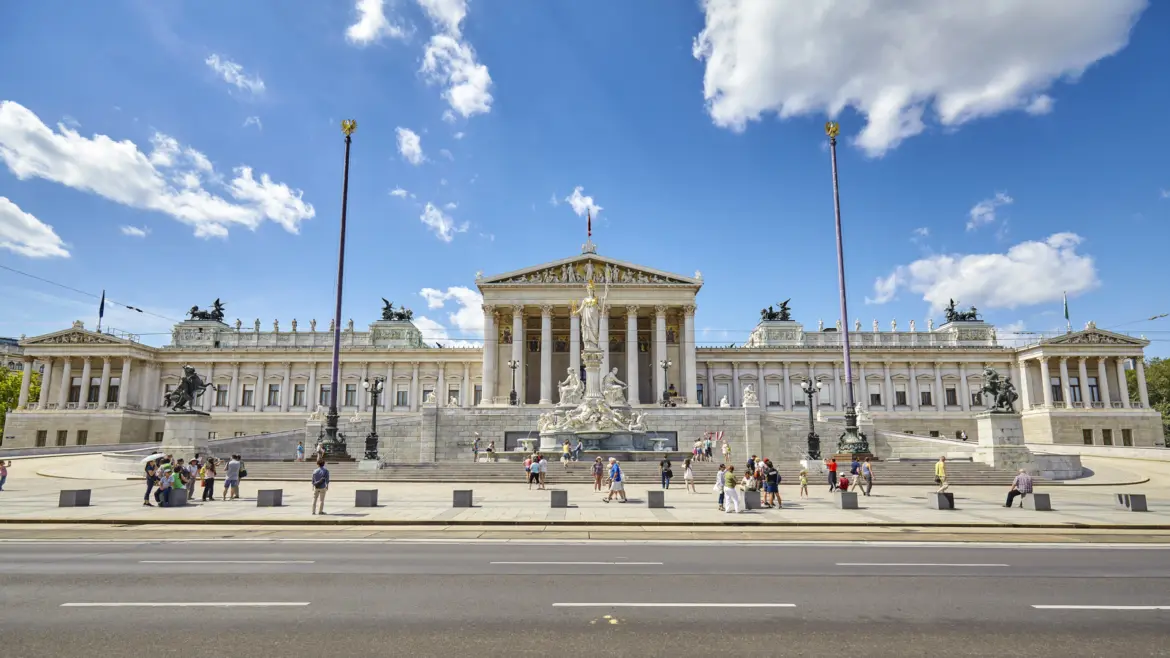
Hello my friends! Vienna is a city where grand architecture tells the story of empires, culture, and political transformation. Along the elegant Ringstrasse, magnificent buildings rise one after another – opera houses, museums, palaces, and institutions that shaped the city’s identity. Among them stands one of Vienna’s most striking landmarks: the Austrian Parliament Building.
Even from a distance, the structure immediately captures the eye. Its long façade of classical columns, gleaming statues, and dramatic staircases evokes the architecture of ancient Greece rather than nineteenth-century Europe. Standing before it, one quickly senses that this building was designed not merely as a seat of government, but as a powerful symbol of democracy, knowledge, and civic life.
Austrian Parliament Building at a Glance
🏛️ Architect: Theophil Hansen — foundation 1874, completed 1883
🇬🇷 Style: Neoclassical, inspired by ancient Greek temple architecture
⚖️ Purpose: Seat of Austria’s National Council and Federal Council — originally the Imperial Council (Reichsrat)
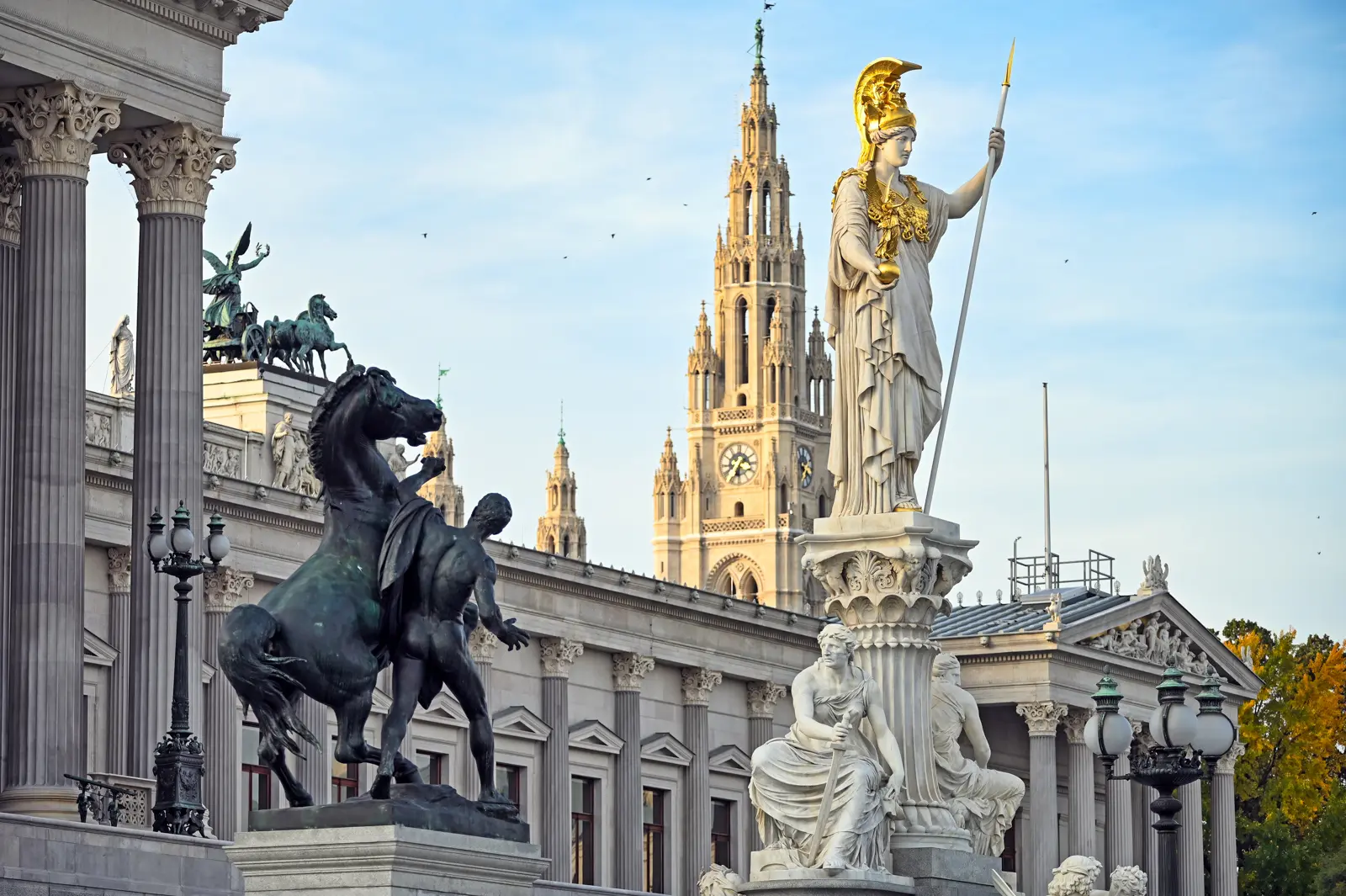
🦉 Pallas Athena Fountain: Goddess of wisdom facing the city, with four river allegories (Danube, Inn, Elbe, Vltava) at the base
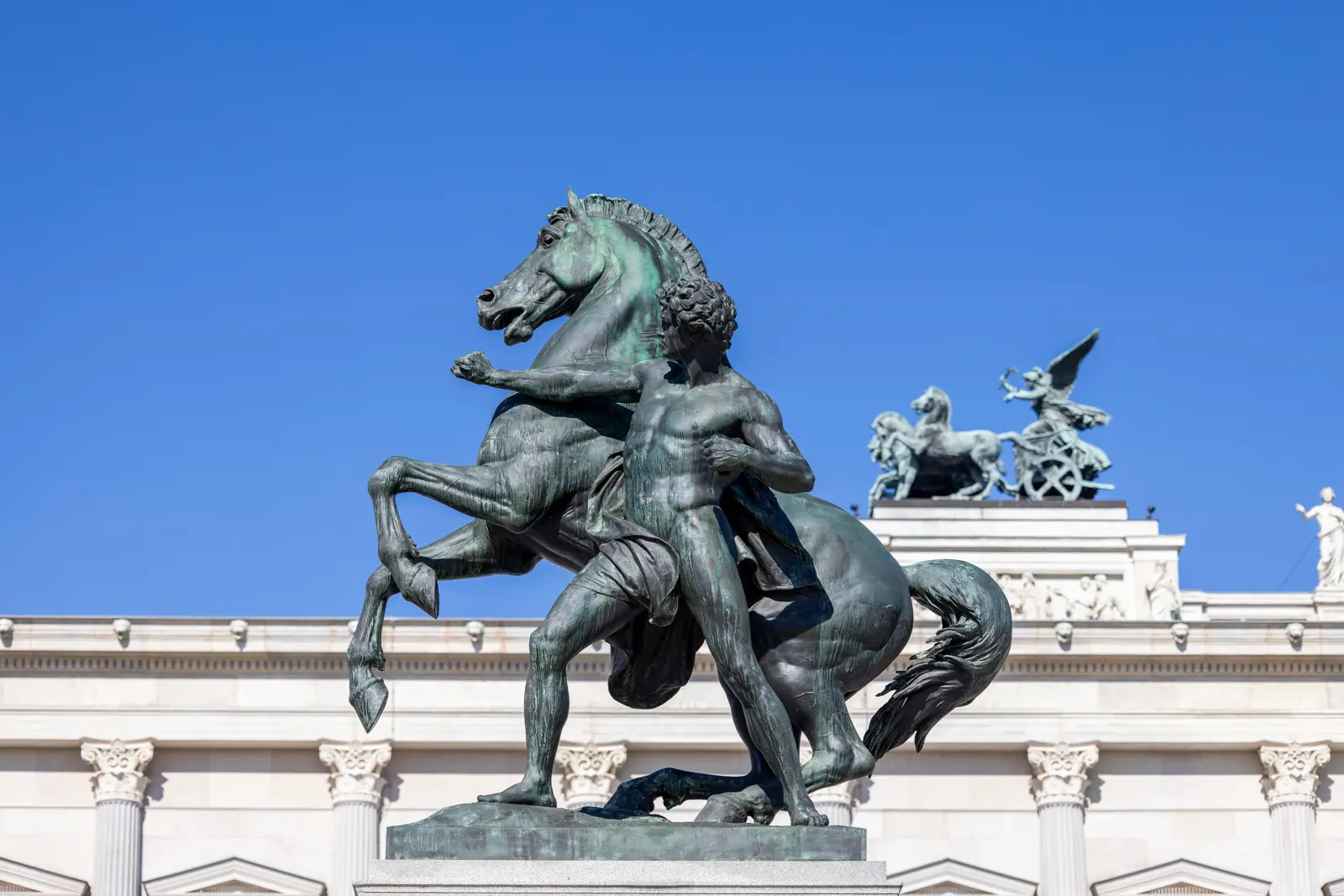
🐎 Horse Tamers: Four bronze sculptures by Josef Lax (1897–1900) symbolizing the restraint of passion
🦅 Griffins: Classical guardians of vigilance and strength
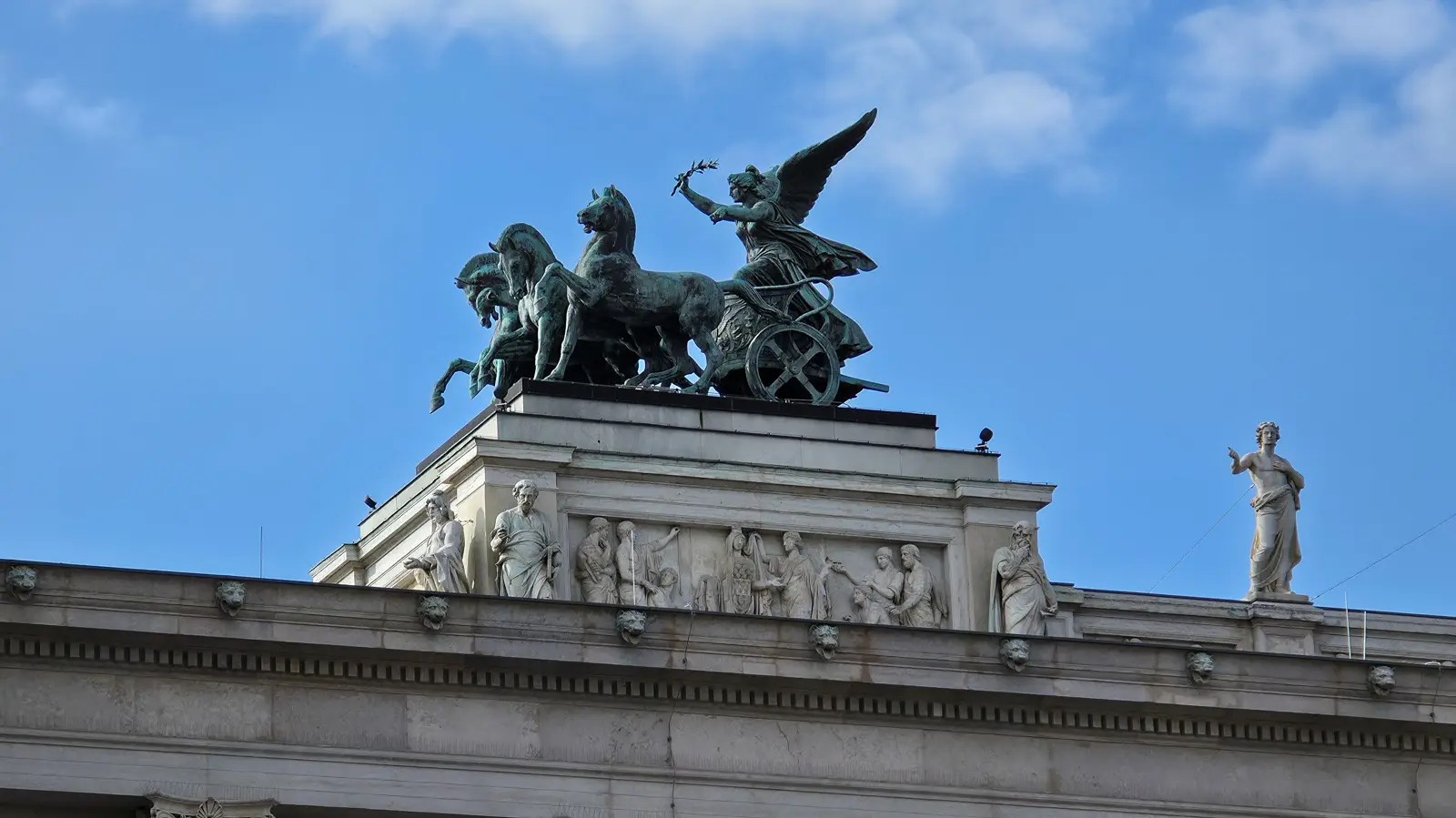
🏇 Quadrigas: Nike guiding chariots of four horses on the roofline — triumph of law and civic order
🔧 Restoration: Comprehensive modernization completed early 2023
💡 Tip: Late afternoon light makes the marble façade glow — ideal for photography
A Monument on Vienna’s Ringstrasse
The Austrian Parliament Building occupies a prominent position along the Ringstrasse, Vienna’s grand boulevard created in the nineteenth century when the old city walls were removed and replaced with a monumental urban avenue. This ambitious redevelopment transformed Vienna into a showcase of imperial architecture, where government buildings, cultural institutions, and museums were designed to reflect the prestige and ambition of the Habsburg Empire.
The foundation stone was laid in 1874 and the building was completed in 1883. It was conceived as the seat of the Imperial Council (Reichsrat) of the Austro-Hungarian Empire, the legislative body representing the empire’s western territories. Its location on the Ringstrasse placed it at the center of Vienna’s political and cultural life, surrounded by other monumental structures such as the Rathaus (City Hall) and the Burgtheater. The building’s commanding presence was intended to express stability, authority, and the ideals of representative government.
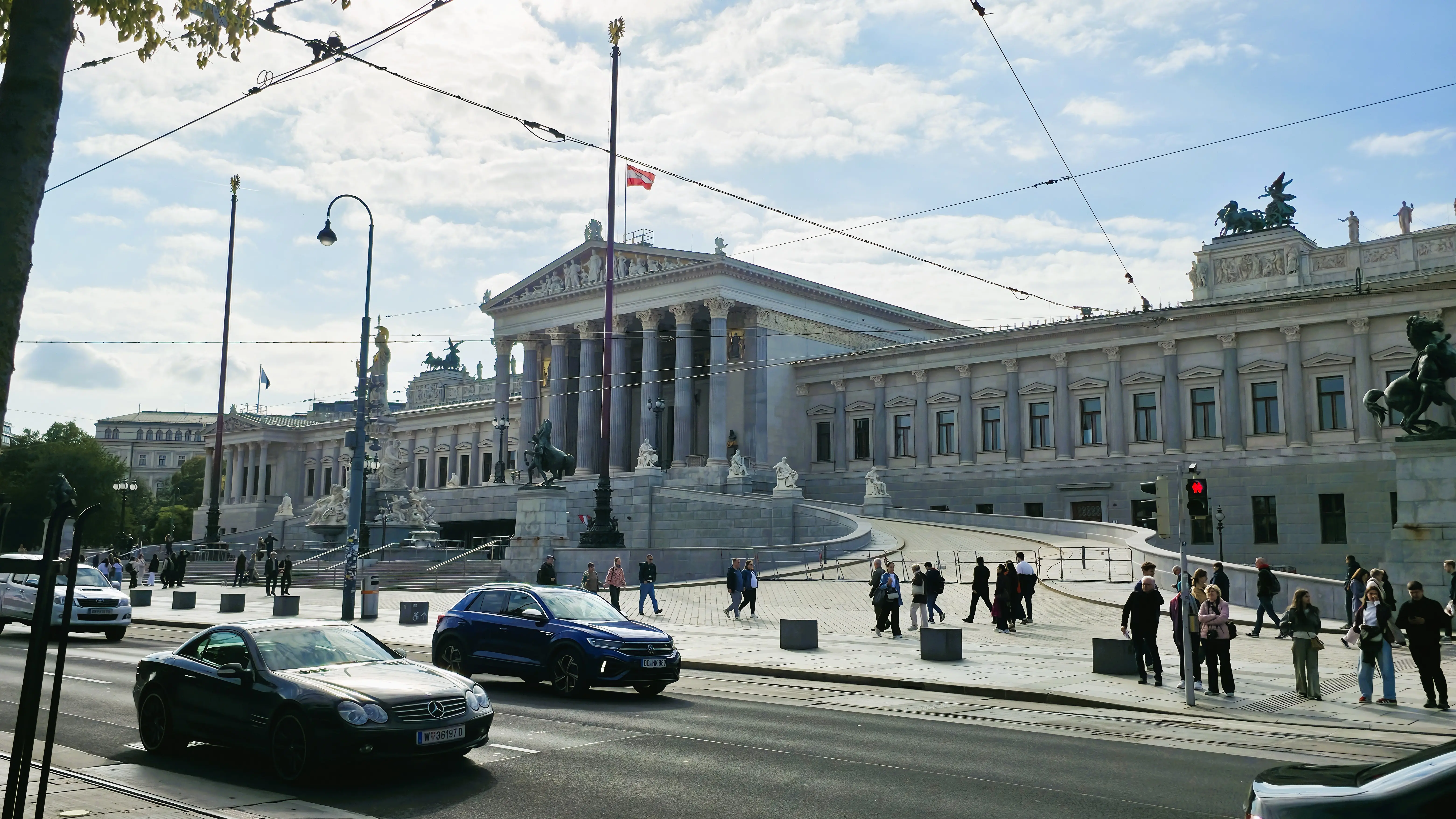
The parliament building suffered significant damage during World War II, particularly during Allied bombing and the final battles of the Vienna Offensive in 1945. In the decades that followed, extensive restoration efforts gradually returned the structure to its former grandeur. More recently, the building underwent a comprehensive modernization and restoration completed in early 2023, allowing the historic monument to shine once again.
Walking along the boulevard today, visitors quickly notice that the parliament building stands out from its neighbors. While many Ringstrasse structures draw inspiration from Renaissance or Baroque styles, the parliament building looks unmistakably ancient, as though a fragment of classical Athens had been transported to the heart of Vienna.
The Vision of Architect Theophil Hansen
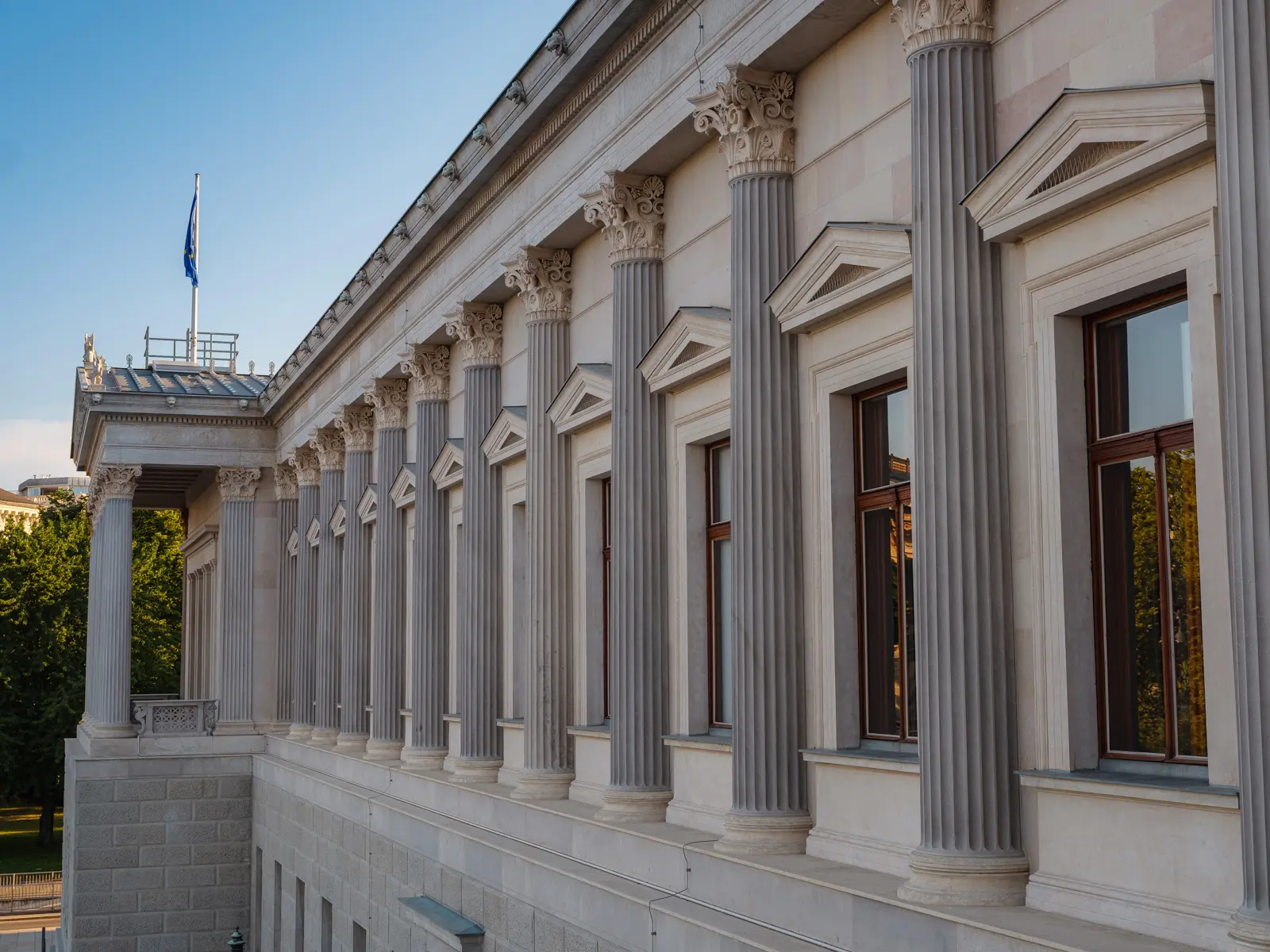
The design of the building was entrusted to the Danish-Austrian architect Theophil Hansen, one of the most influential architects of Vienna’s Ringstrasse era. Hansen’s affinity for classical Greek architecture was not merely academic – he had spent years in Athens beginning in 1837, carefully studying, measuring, and documenting ancient monuments. This experience left a deep and lasting impression on his architectural vision. When he was commissioned to design the parliament building in 1869, he regarded the project as the crowning achievement of his career.
Hansen deliberately chose the architectural language of ancient Greece to reflect the origins of democratic governance. Greek temples and civic buildings served as inspiration for the structure’s imposing colonnades, symmetrical layout, and monumental staircases. By drawing on classical Greek forms, Hansen sought to evoke the ideals of civic debate, philosophical inquiry, and democratic participation that first emerged in ancient Athens. Elements of the main entrance portico were inspired by structures on the Acropolis – including the elegant proportions associated with the Erechtheion – reinforcing the building’s symbolic connection to classical Greece.
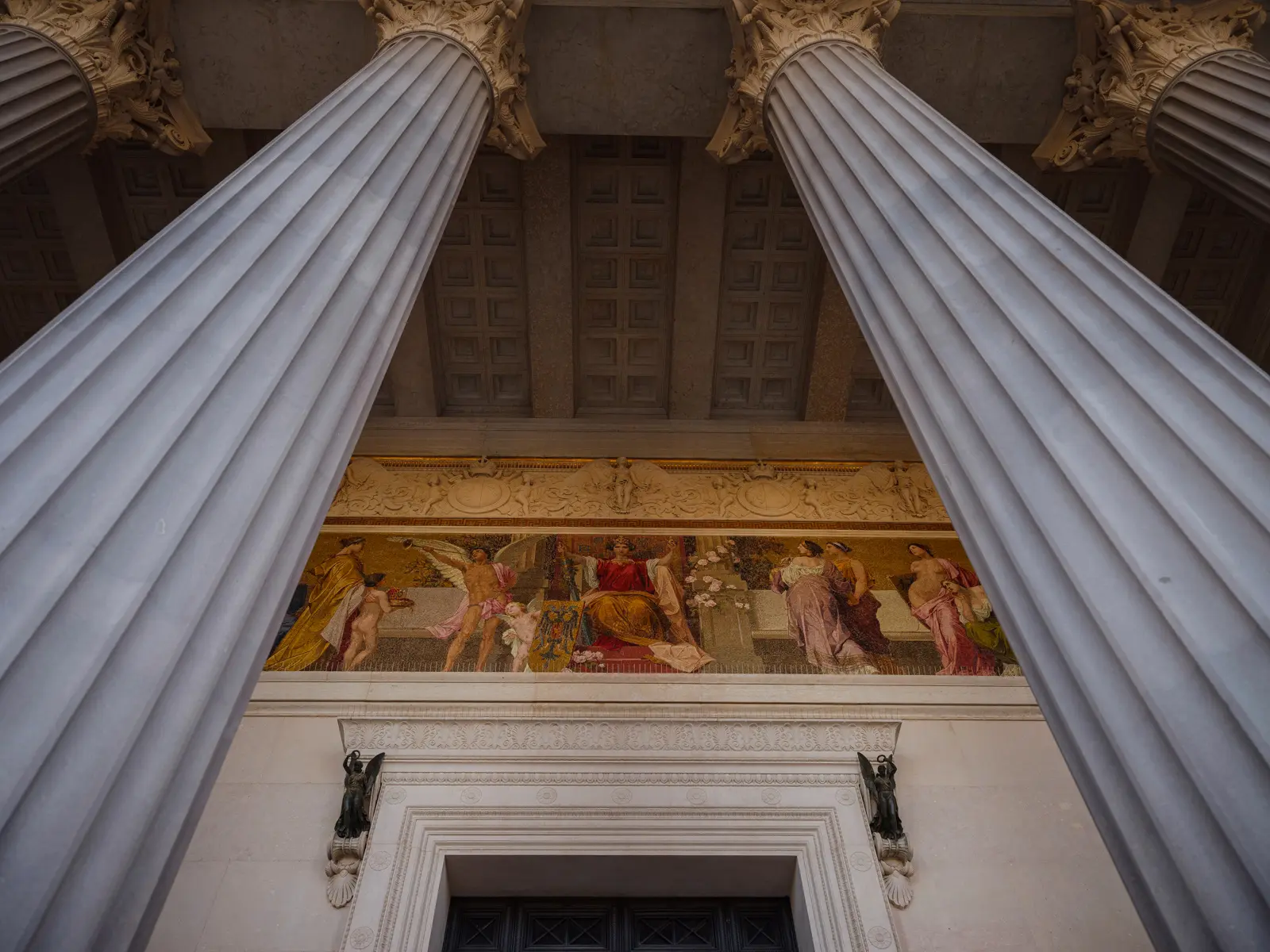
The building is constructed largely from bright white marble and limestone, giving it a luminous appearance that contrasts beautifully with the surrounding architecture. The façade stretches across an impressive width, framed by towering Corinthian columns that support an elaborately decorated pediment. This deliberate evocation of classical Greece was not merely aesthetic – it was meant to communicate that the parliament was a place where ideas, laws, and political dialogue would shape the future of the state. Franz Joseph I later honoured Hansen’s achievement by granting him the noble title of Freiherr – Baron – following the building’s successful completion.
The Pallas Athena Fountain
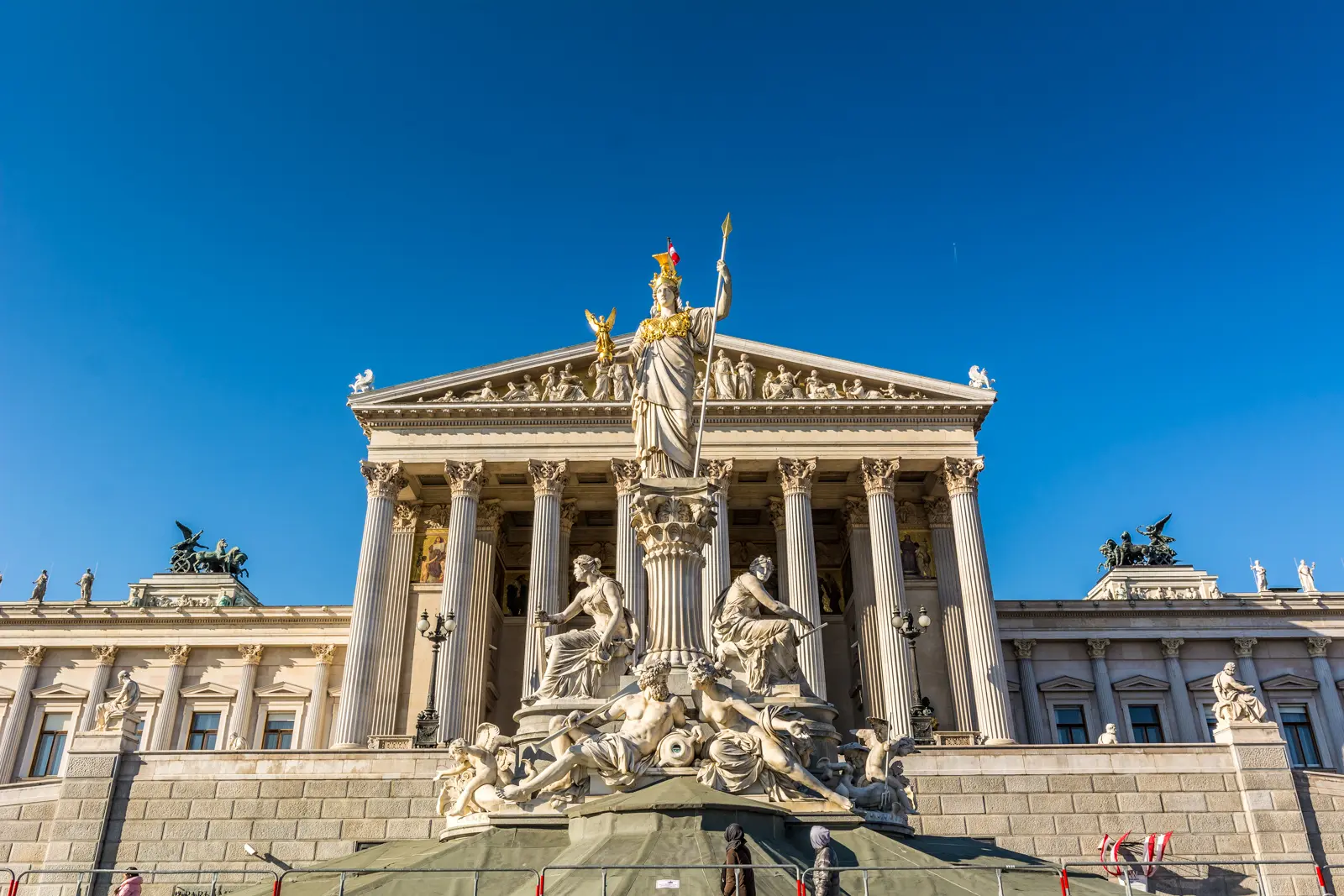
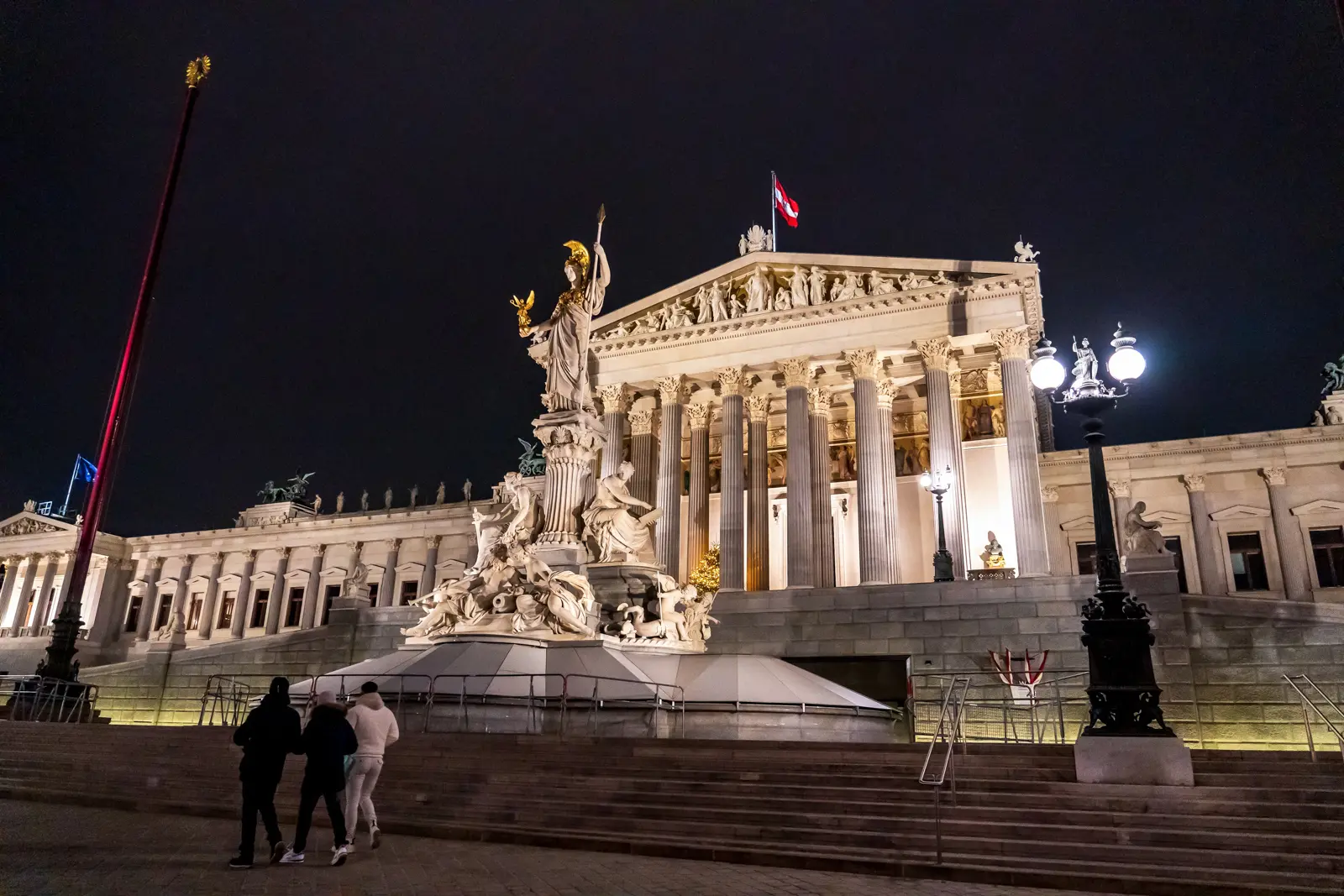
One of the most iconic features of the parliament building stands directly in front of the main staircase: the magnificent Pallas Athena Fountain. Created between 1893 and 1902 by sculptors Carl Kundmann, Josef Tautenhayn, and Hugo Haerdtl – based on plans by architect Theophil Hansen – the fountain quickly became one of Vienna’s most recognizable monuments.
At the center rises the towering figure of Athena, the ancient Greek goddess of wisdom and strategic warfare. Clad in armor and crowned with a helmet, she stands confidently above the fountain basin, holding a spear and the small figure of Nike, the goddess of victory. The column beneath her is adorned with four owls – timeless symbols of wisdom – that support the statue above. Athena faces outward toward the city rather than toward the parliament building itself, a design choice that has inspired one of Vienna’s most enduring jokes: that the goddess has turned her back on the politicians inside.
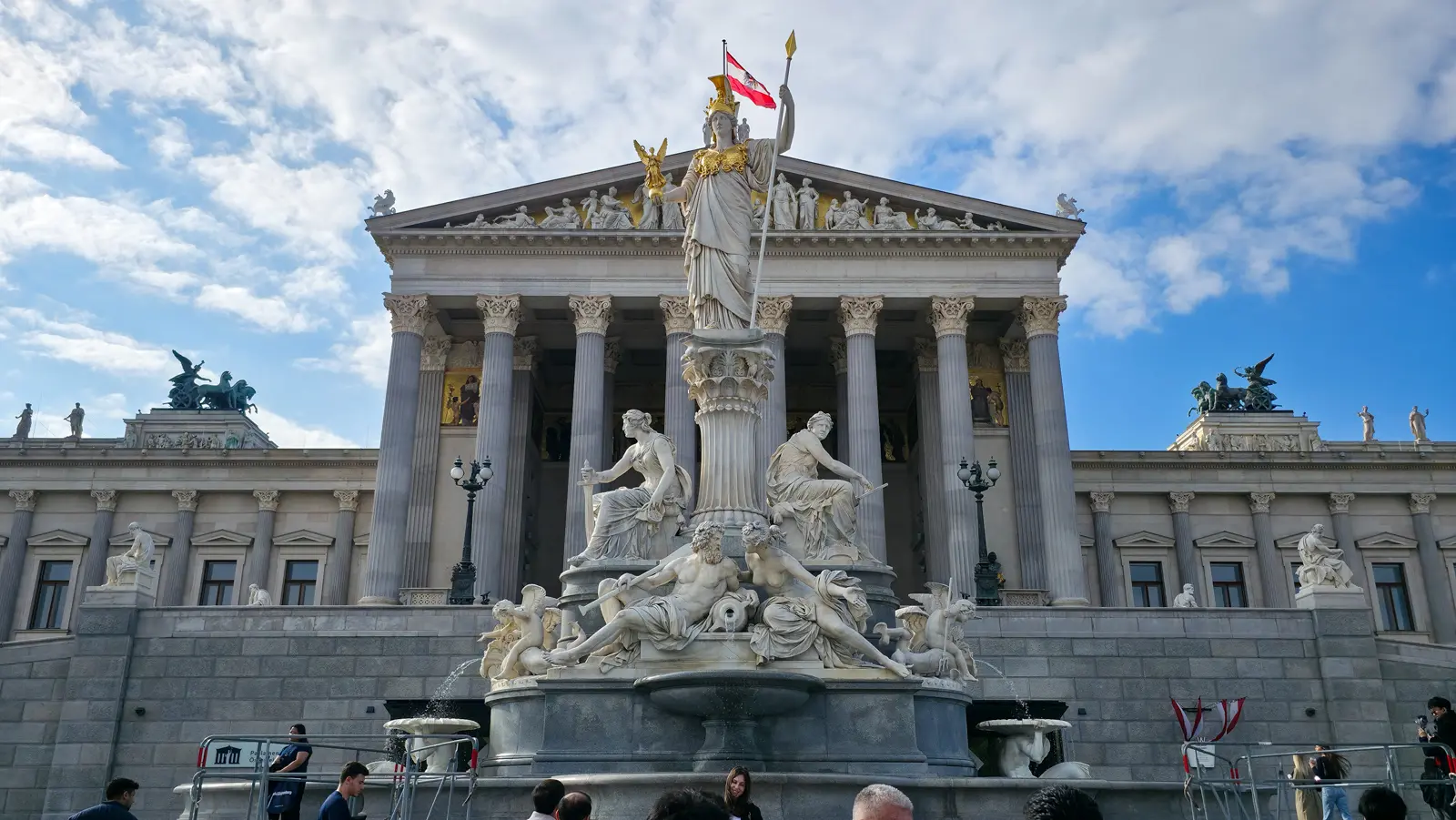
Around the base of the monument are allegorical sculptures representing four great rivers of the former Austro-Hungarian Empire: the Danube, the Inn, the Elbe, and the Vltava (Moldau). These reclining figures symbolize the geographic reach and prosperity of the empire. Additional allegorical figures surrounding the fountain represent the legislative and executive powers of the state, reinforcing the idea that wisdom and governance must work together.
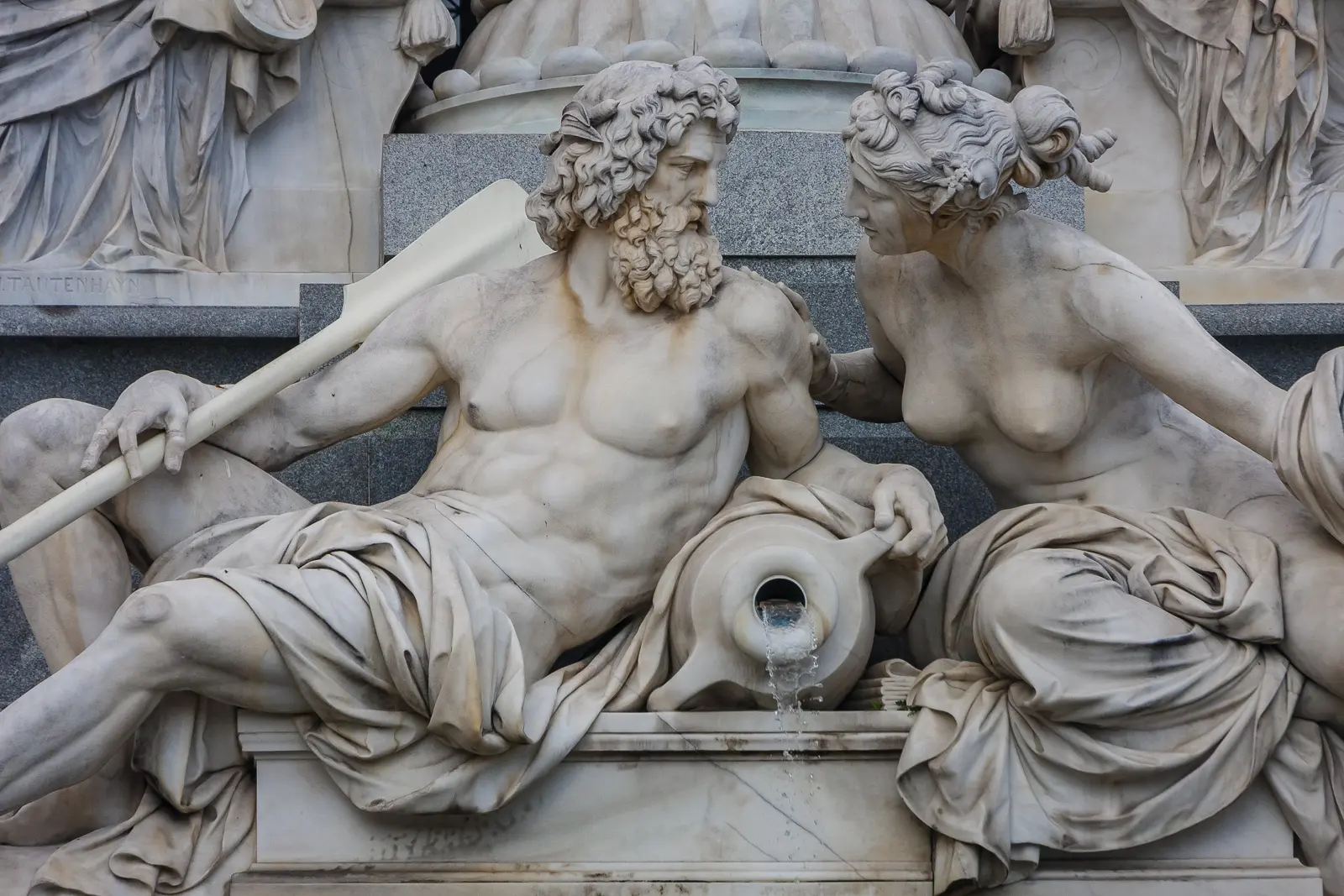
The fountain’s dramatic composition – flowing water, gleaming bronze and marble, and mythological symbolism – makes it one of the most photographed spots in Vienna and one of the most rewarding monuments to explore slowly.
Sculptures, Symbols, and Mythology
The parliament building is not merely a structure; it is an enormous sculptural program filled with symbolic figures drawn from classical mythology and ancient history. These sculptures were intended to communicate values associated with democratic governance, intellectual life, and civic virtue.
Lining the two great ramps that lead to the building’s entrance stand eight celebrated historians (four Greek and four Roman) whose writings shaped our understanding of politics, war, and power. The Greek historians Herodotus, Thucydides, Xenophon, and Polybius stand alongside the Roman historians Julius Caesar, Tacitus, Livy, and Sallust. Their presence reflects the intellectual heritage that underpins democratic debate and political reflection.
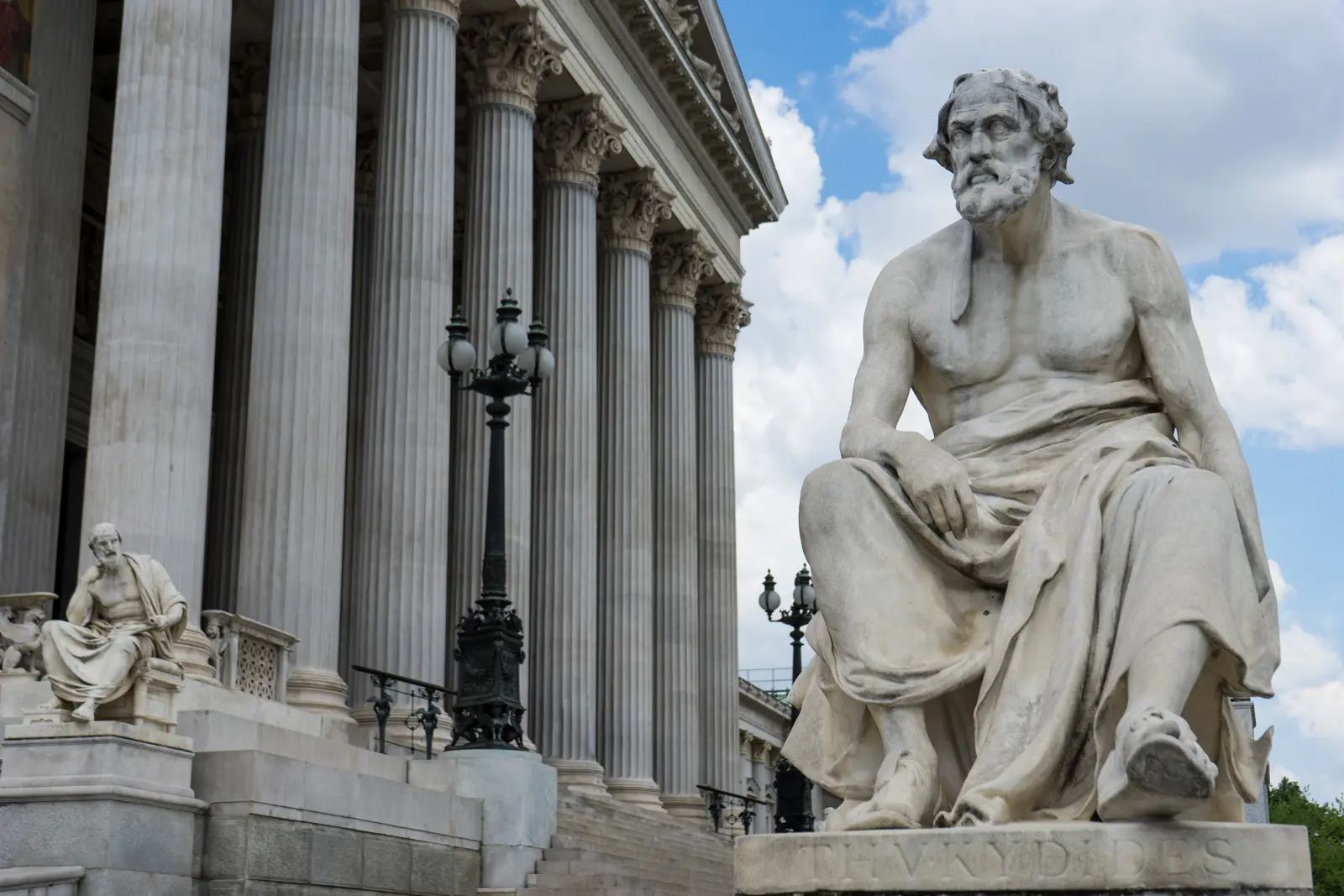
One connection is particularly fitting for Vienna: Xenophon wrote an early treatise on the art of riding whose instructions are considered a foundational influence on the tradition of classical horsemanship practiced at the nearby Spanish Riding School.
Elsewhere, visitors encounter majestic griffins guarding parts of the complex – mythical creatures with the body of a lion and the head of an eagle. In classical symbolism, griffins represent vigilance and strength, appropriate guardians for a building devoted to lawmaking and governance.
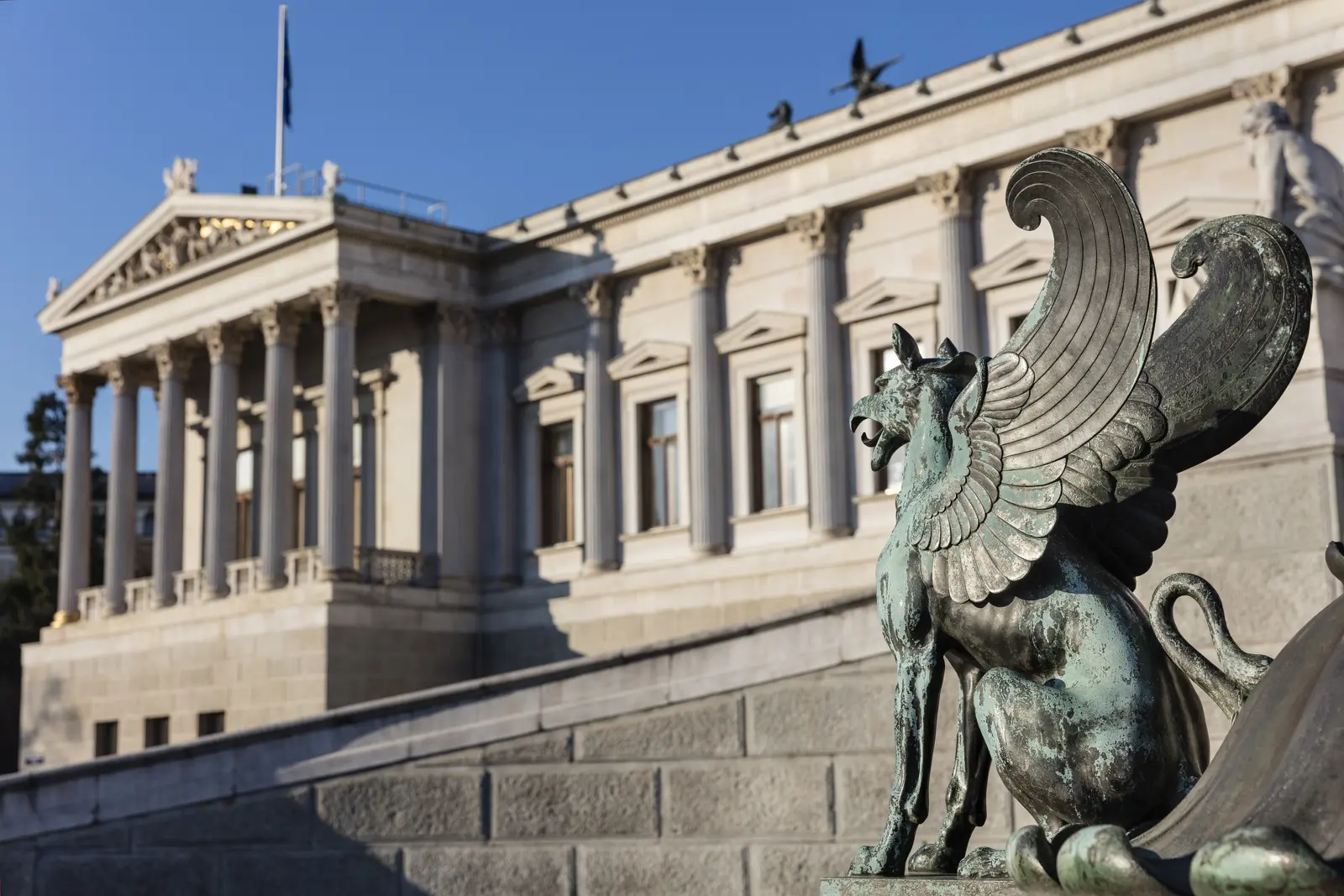
Every corner of the structure reveals another layer of symbolism. The statues, reliefs, and allegorical figures together create a visual narrative about power, wisdom, and responsibility in public life.
The Bronze Horse Tamers
At the foot of the ramps leading to the portico stand four impressive bronze sculptures known as the Horse Tamers, created by the Austrian sculptor Josef Lax between 1897 and 1900. Arranged in two dramatic groups on either side of the staircase, these dynamic statues depict powerful men struggling to control rearing horses – a striking representation of strength, discipline, and mastery.
The symbolism is deliberate and precise: the sculptures represent the restraint of passion, considered an essential precondition for successful parliamentary cooperation. Just as the tamers guide the raw energy of the horses, lawmakers are meant to channel the powerful forces of society through reason, law, and debate. The muscular forms and expressive movement of the figures add a sense of dramatic tension to the otherwise balanced and classical façade of the building – a reminder that governance, for all its ordered ideals, is always a struggle with powerful and unpredictable forces.
The Quadrigas on the Roof
High above the parliament building, two magnificent quadrigas crown the roofline, one at each end of the structure. A quadriga is a chariot drawn by four horses, a powerful symbol frequently used in classical architecture to represent victory and triumph. Each chariot is guided by Nike, the winged goddess of victory. From their elevated position above the building, the quadrigas appear to race triumphantly across the skyline of Vienna. These sculptures reinforce the idea that the parliament building represents the triumph of law, governance, and civic order – ideals that connect the modern political system with the philosophical traditions of ancient Greece.
The Parliament Today and Its Enduring Symbolism
Today the Austrian Parliament Building continues to serve as the seat of Austria’s national legislature, housing both the National Council and the Federal Council. Following an extensive restoration completed in 2023, the building now combines its historic architectural grandeur with modern facilities designed for contemporary parliamentary work. Visitors walking around the exterior can admire the extraordinary craftsmanship that went into the structure’s design. Even without entering the interior, the architecture itself tells a powerful story about the aspirations of the nineteenth-century state and the enduring importance of democratic institutions.
Standing before the building today, surrounded by statues of philosophers, mythological figures, historians, and allegorical representations of rivers and virtues, visitors are reminded that architecture can express powerful ideas. The parliament reflects a moment in history when political institutions sought legitimacy through the ideals of classical antiquity – wisdom, debate, and civic responsibility. In this sense, the building is far more than a government complex; it is a monumental tribute to the principles that underpin democratic societies. For travelers exploring Vienna, taking time to study the sculptures and architectural details offers a fascinating glimpse into the intellectual and political ideals that helped shape modern Europe.
Bubbly Tips for Visiting the Austrian Parliament
- Location: The Austrian Parliament Building is located along Vienna’s famous Ringstrasse boulevard, one of the city’s most beautiful historic avenues. The building sits between the Rathaus (City Hall) and the Burgtheater, making it easy to include during a walk through Vienna’s historic center.
- Best time to visit: Late afternoon or early evening is one of the best times to see the parliament building. As the sun begins to set, the marble façade and sculptures glow warmly in the soft light, creating ideal conditions for photographs.
- Don’t miss the Pallas Athena Fountain: Standing directly in front of the parliament building, the Pallas Athena Fountain is one of Vienna’s most impressive monuments. Take time to admire the detailed sculptures and the allegorical river figures at the base.
- Look for the architectural details: Walk around the building slowly to discover the many sculptures, historians, griffins, and mythological figures that decorate the façade. Looking upward, you can also spot the dramatic quadriga chariots on the roof crowned by the winged goddess Nike.
- Combine with nearby landmarks: Because the parliament sits along the Ringstrasse, it pairs perfectly with nearby sights such as the Vienna City Hall (Rathaus), the Burgtheater, and the beautiful Volksgarten park just across the street.
Final Thoughts
The Austrian Parliament Building is one of Vienna’s most captivating architectural landmarks. Its grand colonnades, mythological sculptures, and symbolic figures transform the building into a visual story about democracy, wisdom, and civic responsibility.
Standing before it, one cannot help but admire the ambition of its designers, who sought to connect modern governance with the ideals of ancient Greece. Every statue, every column, and every fountain element contributes to this extraordinary narrative.
Have you visited the Austrian Parliament Building in Vienna, or explored the beautiful Ringstrasse boulevard? I would love to hear your impressions and favorite discoveries, share them in the comments below.
Happy travels!

🌟 Everything You Need to Plan Your Dream Trip in 2026
- 🌟 Luxury Hotels - Find premium stays with Booking.com & Hotels.com
- 🏡 Vacation Rentals - Discover unique properties on VRBO
- 🏞️ Guided Tours - Explore with Viator or GetYourGuide
- 🎫 Attraction Tickets - Skip the lines with Tiqets
- 🚢 Ocean Cruises - Set sail with Cruise Direct
- 📱 International SIMs - Stay connected with Saily
- 🚗 Car Rentals - Budget-friendly options from Discover Cars
- 🌐 Secure VPNs - Browse safely with NordVPN
- 💶 Currency Exchange - Best rates with Wise
- 🗣️ Learn Languages - Master the local language with Babbel and Rosetta Stone